

Automotive Powertrain Systems Market to Reach USD 113.49 Billion by 2035, Growing at 5.7% CAGR
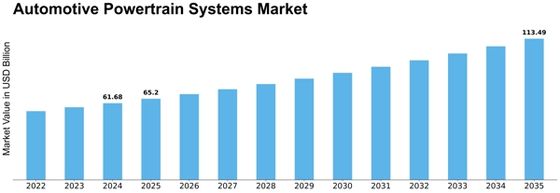
Automotive Powertrain Systems Market
The market is witnessing a pronounced trend towards the electrification of powertrains, particularly in North America.
NEW YORK, NY, UNITED STATES, September 8, 2026 /EINPresswire.com/ -- According to Market Research Future, the Automotive Powertrain Systems Market is projected to reach USD 113.49 Billion, with a CAGR of 5.7% by 2035. This steady growth trajectory reflects the ongoing transformation of the automotive industry, where powertrain systems are evolving from traditional internal combustion engine configurations toward diversified portfolios that integrate electrification, hybridization, and advanced mechanical components. The market's consistent expansion is underpinned by stringent global emission regulations, increasing vehicle production, consumer demand for fuel efficiency, and the accelerating transition toward electric mobility, positioning powertrain systems as a critical area of innovation and investment across all vehicle segments.Market Overview
Automotive powertrain systems encompass the comprehensive suite of components that generate and deliver power from the engine to the vehicle's drive wheels. This includes the engine, transmission, differentials, drive shafts, and various ancillary components that collectively determine vehicle performance, efficiency, and emissions characteristics. The market spans both internal combustion engine configurations and emerging electrified solutions, serving passenger vehicles and commercial vehicles across global markets. As the automotive industry undergoes its most significant transformation in a century, powertrain systems are evolving from purely mechanical assemblies to sophisticated integrated systems that combine mechanical, electrical, and software-driven functionalities.
The growth drivers for the automotive powertrain systems market are diverse and mutually reinforcing. The increasing stringency of global CO2 and fuel-economy regulations stands as the primary catalyst, as regulators in Europe, China, and select United States states enforce stricter fleet-average CO2 caps that push automakers to mainstream electric powertrains . The Euro 7 framework imposes fines for CO2 on every vehicle an OEM registers, making non-compliance financially untenable. China's dual-credit scheme requires a notable share of electric or hybrid sales by 2030 and ties license-plate quotas to progress, accelerating powertrain shifts among domestic brands. California's Advanced Clean Cars II program extends zero-emission targets to medium-duty trucks, compelling fleet operators to re-evaluate asset lifecycles . These converging regulations shrink the addressable market for future ICE launches and compel suppliers to retool for high-volume e-axle production.
📍 Get Free Sample Report for Detailed Market Insights:
https://www.marketresearchfuture.com/sample_request/4793
Market Segmentation
The automotive powertrain systems market is segmented based on component, engine type, vehicle type, and regional analysis to provide a comprehensive understanding of the industry landscape.
By Component: The market is categorized into Engine, Transmission, Differentials, Drive Shafts, and Others. Engines generated the largest slice of the market with approximately 41.63% share in 2025, as automakers continue to produce and refine internal combustion engine programs . However, the "Others" basket, chiefly final drives and compact e-drive units, is projected to outpace all peers with a notable CAGR through 2035, taking advantage of integrated motor-inverter packages that cut weight and assembly steps . Transmissions are ceding share because most battery electric vehicles require a single reduction gear, although multi-speed gearboxes gain relevance for heavy-duty trucks seeking highway efficiency. Differential suppliers are pivoting to electronic torque-vectoring modules synced with software controls rather than mechanical, limited-slip clutches. The component mix is migrating toward fewer, higher-value assemblies governed by power-electronics intellectual property rather than machining expertise . The Automotive Transmission Market remains a critical component segment, with automatic transmissions retaining a dominant market share anchored by North American pickups and SUVs that value towing and refinement . Dual-clutch units and continuously variable transmissions are also experiencing varying growth trajectories, with the two-speed EV gearboxes gaining strategic importance for premium electric vehicles .
By Engine Type: The market is divided into Gasoline and Diesel. Gasoline engines hold the largest market share, attributed to their longstanding presence in the automotive industry, coupled with consumer preferences for performance and fuel efficiency . Their dominance persists due to established supply chains and customer familiarity. Diesel engines, while historically less popular in passenger vehicles, are gradually increasing their market share, fueled by significant advancements in technology that enhance their efficiency and emissions performance . The growth trends indicate a noteworthy shift toward diesel engines, primarily due to the rising demand for fuel-efficient vehicles and stricter emissions regulations worldwide. With advancements in turbocharging and emission control systems, diesel engines are becoming increasingly efficient and environmentally friendly . The emerging trend toward diesel is marked by a concerted effort from manufacturers to enhance their appeal through innovative technologies, which positions them as a compelling alternative to traditional gasoline engines in various vehicle types . While gasoline remains dominant, the diesel segment is expected to experience substantial growth in the coming years .
By Vehicle Type: The market is segmented into Passenger Vehicles and Commercial Vehicles. Passenger vehicles constitute the largest segment, representing a significant portion of the overall market share, benefiting from widespread consumer preference, high production volumes, and robust sales figures . These vehicles typically emphasize efficiency, comfort, and advanced technology, reflecting consumer demands for quality and innovation. Commercial vehicles, although smaller in share, are rapidly gaining ground due to an increase in logistics, e-commerce, and delivery services, leading to an uptick in demand for efficient powertrain solutions . This sector is focused on durability and fuel efficiency, creating opportunities for advancements in powertrain technologies such as electric and hybrid systems to meet stringent emissions regulations . The commercial vehicle segment benefits from fleet electrification mandates and the growing adoption of automated manual transmissions to address driver shortages .
By Region: The market analysis covers North America, Europe, Asia-Pacific, and Rest of the World. Asia-Pacific dominates the global market, driven by massive automotive production in China, Japan, South Korea, and India, coupled with rapid technological adoption and expanding consumer spending on vehicle features . The region's growth is fueled by government initiatives promoting electric vehicles and clean energy technologies .
🛒 You can buy this market report at:
https://www.marketresearchfuture.com/checkout?currency=one_user-USD&report_id=4793
Regional Analysis
Asia-Pacific represents the largest and fastest-growing regional market for automotive powertrain systems, driven by massive automotive production capabilities and rapidly evolving regulatory frameworks. China leads the region with the world's largest automotive manufacturing base and aggressive government initiatives promoting electric vehicles and intelligent connected vehicles . China accounts for approximately 45% of the total regional share, followed by Japan at around 20% . The country's updated dual-credit system has incentivized the use of specialized hybrid transmissions, with automakers like BYD leading with dedicated hybrid powertrains . China's push toward plug-in vehicles is expected to significantly increase adoption among new cars . Japan and South Korea continue to demonstrate strong demand for advanced powertrain technologies, with leading OEMs investing heavily in hybrid and electric drivetrain development. India is emerging as a significant market, with the commercial vehicle segment benefiting from e-commerce growth and last-mile delivery services . The region's growth is fueled by rapid urbanization, increasing disposable incomes, and government incentives such as subsidies for EV purchases and investments in charging infrastructure .
North America remains a mature yet dynamic market, characterized by strong consumer demand for fuel-efficient vehicles and stringent emissions regulations . The United States holds the largest market share at approximately 60% within the region, followed by Canada at around 20% . Regulatory catalysts such as the Corporate Average Fuel Economy standards are pushing manufacturers to innovate and enhance powertrain technologies . The U.S. 2027-2031 CAFE rules finalized in 2024 demand a 58-mile-per-gallon fleet average by 2031, compelling eight-plus-speed automatics and advanced transmissions . Major players like General Motors, Ford, and Toyota are leading the charge with significant investments in electric and hybrid powertrains . The region witnessed a rise in 10-speed automatics for trucks like the Ford F-150 and a shift to single-speed transmissions for electric crossovers such as the Mustang Mach-E . The competitive landscape is characterized by established manufacturers and a growing focus on sustainability, shaping the market dynamics in North America .
Europe represents a technologically advanced market with strong emphasis on sustainability, innovation, and environmental regulations . The European Union's Green Deal aims to reduce greenhouse gas emissions, driving the push for electric vehicles . The region is at the forefront of automotive powertrain innovation, with Germany and France holding approximately 50% and 15% market shares, respectively . Euro 7, effective January 2025, limits on-road nitrogen oxides to 60 mg/km, pushing diesel models toward 10-speed units that curb transient spikes . Major players like Volkswagen, BMW, and Daimler AG are actively investing in advanced powertrain technologies, with BMW's multi-energy vehicle architecture enabling a single vehicle platform to deploy ICE, PHEV, and BEV configurations . The competitive landscape is marked by collaborations between automakers and technology firms to develop next-generation powertrains, with the focus on electrification and hybridization reshaping the market and positioning Europe as a leader in automotive innovation .
Rest of the World, encompassing Latin America, the Middle East, and Africa, represents diverse markets with varying growth trajectories. Latin American markets, particularly Brazil, show steady growth supported by recovering vehicle production and increasing consumer demand for modern vehicles. Brazil's Rota 2030 initiative supports local production of more efficient automatic transmissions . The Middle East demonstrates strong demand for premium vehicles equipped with advanced powertrain technologies, while African markets remain at nascent stages but hold potential as automotive infrastructure develops and vehicle ownership rates increase. South America is emerging as the fastest-growing region in certain transmission segments, driven by local production initiatives and import tariffs encouraging domestic assembly .
Competitive Landscape and Key Players
The automotive powertrain systems market is highly competitive, featuring a mix of established global automotive suppliers, specialized component manufacturers, and emerging technology players. Leading companies are focusing on strategic partnerships, technological innovation, capacity expansion, and portfolio diversification to strengthen their market positions .
Key players operating in this space include Robert Bosch GmbH, Denso Corporation, ZF Friedrichshafen AG, Magna International Inc., Aisin Corporation, BorgWarner Inc., Hyundai Transys, Schaeffler AG, GKN Automotive, Allison Transmission Inc., Dana Incorporated, Valeo SA, JTEKT Corporation, Cummins Inc., Mahle GmbH, BYD Auto Co., Ltd., and Tesla, Inc. . Honda Motor Co., Ltd. is a global leader in the automotive and powertrain industries with expertise in gasoline engines, hybrid systems (including the popular two-motor hybrid i-MMD architecture), hydrogen fuel cell technology, and the new 0 series battery-electric platform . Nissan Motor Co., Ltd. is the inventor of e-POWER, a proprietary series-hybrid architecture that uses an internal combustion engine solely as a generator to charge the battery, delivering the smooth electric driving experience of a BEV without requiring external charging infrastructure . Mercedes-Benz Group AG, formerly Daimler AG, focuses on premium and luxury passenger cars with powertrain lineup comprising advanced AMG-tuned internal combustion engine platforms, plug-in hybrid drivetrains, and an expanding variety of battery-electric Mercedes-EQ cars .
Strategic developments are reshaping the competitive landscape. Major suppliers are forming partnerships and joint ventures to develop next-generation powertrain technologies and secure battery supply chain vertical integration . The automotive powertrain systems market experienced significant consolidation and strategic alliance activity between 2022 and 2026, as OEMs pursued EV platform co-investment, battery supply chain vertical integration, and shared powertrain architecture development to reduce per-unit electrification costs . Notable developments include the completion of the Daimler Truck (ARCHION) commercial vehicle demerger and listing on the Tokyo Stock Exchange Prime Market . Nissan Motor Co. has been involved in merger talks to create the world's third-largest automaker, sharing BEV and hybrid powertrain platform R&D costs . Sumitomo Metal Mining and Idemitsu Kosan have formed joint ventures to develop cathode materials and lithium sulfide solid electrolyte for solid-state battery mass production deployment .
Latest Industry News and Developments
Recent industry developments reflect the dynamic nature of the automotive powertrain systems market. Bosch is scaling silicon carbide production across Reutlingen and Roseville, with plans for approximately EUR 650 million of investment in Reutlingen between 2026 and 2029, while its Roseville conversion is part of a USD 2 billion investment supported by a USD 225 million U.S. Department of Commerce funding agreement . Commercial production on 200-mm wafers is planned for 2026 .
ZF launched the SELECT modular electric-drive platform in 2025, with a 150-300 kW range and a stated peak efficiency of up to 96.3% . The company also commenced mass production of a next-generation asynchronous motor in Hangzhou, China, in June 2025 . Hyundai Motor Group established EV-component production capacity at HMGMA in Georgia, where Hyundai Mobis produces battery systems and key modules . BorgWarner announced in October 2025 that it will supply a leading Chinese OEM with a 7-in-1 integrated drive module, and separately secured an 800V bidirectional onboard charger agreement with a North American OEM . Continental introduced its eRTS EV-motor heat sensor in June 2025 and continues to develop hose, pipe, and cooling architectures for battery thermal management .
Market Challenges and Opportunities
The automotive powertrain systems market faces several challenges that could impact growth trajectories. Critical-mineral supply-chain volatility and price swings present significant challenges, with lithium carbonate prices experiencing substantial fluctuations between 2022 and 2024, compelling battery makers to adjust contracts quarterly and disrupting cost forecasts . Mining concentration in Chile, Australia, and China, plus a significant Chinese share of refining capacity, exposes OEMs to geopolitical shocks . High system cost and complexity of multi-speed electrified drivelines add further challenges, as adding an extra ratio can inflate EV drivetrain cost by USD 400-600 and increase weight, requiring dedicated cooling management . The transition from internal combustion engine systems to electric powertrains requires substantial investment in new manufacturing capabilities, retooling, and workforce training. ICE systems still represent a significant share of revenue in 2025 but are expected to decline notably by 2035 as battery electric vehicles accelerate .
Emerging opportunities are abundant in the evolving market landscape. The shift toward software-defined vehicles presents enormous potential for powertrain systems, as vehicles increasingly become platforms for continuous software innovation and feature upgrades. The growing demand for electric vehicles creates new opportunities for specialized powertrain components, including integrated motor-inverter packages, advanced battery management systems, and high-efficiency thermal management solutions .
To explore more market insights, visit us at:
https://www.marketresearchfuture.com/reports/automotive-powertrain-systems-market-4793
Final Market Summary
The transition toward software-defined vehicles and connected mobility platforms represents a fundamental shift in the industry, positioning powertrain systems as integral components of broader vehicle ecosystems. As vehicles increasingly function as connected digital platforms, the importance of sophisticated powertrain solutions that support over-the-air updates, predictive maintenance, and real-time optimization will only continue to grow, ensuring robust demand and market expansion throughout the forecast period and beyond .
More Related Reports from MRFR Library:
Hydrostatic Transmission Market : https://www.marketresearchfuture.com/reports/hydrostatic-transmission-market-6275
Truck Platooning Market : https://www.marketresearchfuture.com/reports/truck-platooning-market-6278
Autonomous Vehicle ECU Market : https://www.marketresearchfuture.com/reports/autonomous-vehicle-ecu-market-6286
Climate Control System for Commercial Vehicle Market : https://www.marketresearchfuture.com/reports/climate-control-system-commercial-vehicle-market-6328
Green Tires Market : https://www.marketresearchfuture.com/reports/green-tires-market-6340
Automotive Fasteners Market : https://www.marketresearchfuture.com/reports/automotive-fasteners-market-6399
Torque Vectoring Market : https://www.marketresearchfuture.com/reports/torque-vectoring-market-6654
Advanced Tires Market : https://www.marketresearchfuture.com/reports/advanced-tires-market-6668
Hydraulic Gear Pump Market : https://www.marketresearchfuture.com/reports/hydraulic-gear-pump-market-6768
Automotive Collision Avoidance System Market : https://www.marketresearchfuture.com/reports/automotive-collision-avoidance-system-market-6773
Market Research Future
Market Research Future
+1 855-661-4441
email us here
Legal Disclaimer:
EIN Presswire provides this news content "as is" without warranty of any kind. We do not accept any responsibility or liability for the accuracy, content, images, videos, licenses, completeness, legality, or reliability of the information contained in this article. If you have any complaints or copyright issues related to this article, kindly contact the author above.
