

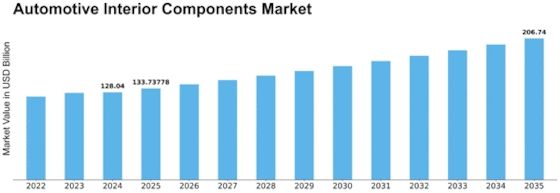
Automotive Interior Components Market to Reach USD 206.74 Billion by 2035, Growing at 4.45% CAGR
Automotive Interior Components Market
The North American region remains the largest market for automotive interior components, driven by high consumer demand for luxury and comfort.
NEW YORK, NY, UNITED STATES, September 8, 2026 /EINPresswire.com/ -- According to Market Research Future, the Automotive Interior Components Market is projected to reach USD 206.74 Billion, with a CAGR of 4.45% by 2035. This steady growth trajectory reflects the profound transformation occurring within vehicle cabins, where interior components are evolving from purely functional assemblies into sophisticated, technology-integrated spaces that define the modern driving experience. The market's consistent expansion is underpinned by rising consumer expectations for comfort, connectivity, and personalization, coupled with automakers' strategic focus on interior design as a key brand differentiator. As vehicles transition toward electric and software-defined architectures, the importance of innovative interior solutions continues to grow, creating sustained demand across all vehicle segments.Market Overview
Automotive interior components encompass the comprehensive range of parts and systems that constitute the vehicle cabin environment. This includes infotainment systems, instrument clusters, telematics units, flooring materials, door panels, automotive seats, interior lighting, and various trim elements that collectively define the interior aesthetic and functionality. These components serve multiple critical functions, from providing occupant comfort and safety to enabling connectivity, entertainment, and vehicle control through advanced human-machine interfaces.
The growth drivers for the automotive interior components market are diverse and interconnected. Rising disposable incomes and changing consumer lifestyles are fueling demand for premium, feature-rich interiors across all vehicle segments. Consumers increasingly view vehicle interiors as extensions of their personal spaces, seeking luxurious materials, advanced connectivity, and customizable ambient environments. The booming global automotive industry, with steady production growth particularly in emerging economies, provides the fundamental demand base for interior components .
Vehicle electrification represents a transformative force reshaping interior design priorities. Electric vehicles offer new packaging opportunities with flat floors, simplified consoles, and flexible cabin layouts that enable lounge-style seating and integrated display surfaces . Automakers are leveraging these opportunities to create distinctive interior experiences that differentiate their electric offerings from conventional vehicles. The shift toward shared mobility and autonomous driving further expands the possibilities for interior innovation, as vehicles increasingly become mobile living and working spaces.
Technological developments are accelerating the evolution of automotive interiors at an unprecedented pace. The integration of advanced display technologies, including curved OLED screens, head-up displays, and pillar-to-pillar digital clusters, is transforming the visual landscape of vehicle cabins. Connectivity solutions, enabled by 5G and cloud computing, are turning vehicles into connected digital platforms that deliver seamless infotainment, over-the-air updates, and personalized services . Artificial intelligence is making significant inroads, enabling adaptive seating, voice assistants, predictive climate control, and personalized infotainment that learns from driver behavior and preferences .
Policy and regulatory influences are shaping market dynamics significantly. Stringent safety regulations, including occupant protection standards and pedestrian safety requirements, influence interior component design and material selection. Environmental regulations targeting vehicle emissions and material sustainability are accelerating the adoption of lightweight materials, recycled polymers, and bio-based surfaces. Regulatory frameworks such as EU REACH, end-of-life vehicle rules, and evolving OEM sustainability targets are transforming sourcing strategies and product engineering approaches .
The demand outlook for automotive interior components remains robust, driven by the continuous evolution of vehicle design, increasing consumer expectations, and the transformation of vehicles toward connected, autonomous platforms. The market's growth is further supported by the rising vehicle parc globally, creating sustained demand for replacement components and aftermarket upgrades.
📍 Get Free Sample Report for Detailed Market Insights:
https://www.marketresearchfuture.com/sample_request/3786
Market Segmentation
The automotive interior components market is segmented based on components, vehicle type, and regional analysis to provide a comprehensive understanding of the industry landscape.
By Components: The market is categorized into Infotainment, Instrument Cluster, Telematics, Flooring, Door Panel, Automotive Seat, and Interior Lighting. Infotainment systems represent a cornerstone of the interior experience, integrating entertainment, navigation, and connectivity functionalities into seamless user interfaces. The Automotive Seating System and Components Market is experiencing significant growth as seating evolves from basic functionality to intelligent, adaptive systems incorporating heating, cooling, massage, and occupant sensing capabilities. Instrument clusters are transitioning from analog gauges to fully customizable digital displays offering enhanced driver information and personalization options. Telematics systems enable vehicle tracking, remote diagnostics, and emergency services, while flooring and door panels contribute to cabin aesthetics, acoustic insulation, and thermal comfort. Automotive interior ambient lighting has emerged as a key differentiator, with advanced lighting systems creating personalized cabin atmospheres and enhancing the overall user experience. The Automotive Interior Ambient Lighting Market is growing rapidly as automakers leverage lighting to create distinctive brand identities and improve perceived vehicle quality.
By Vehicle Type: The market is divided into Passenger Vehicles and Commercial Vehicles. Passenger vehicles dominate the market, driven by high production volumes and consumer demand for premium in-car experiences. Luxury and mid-range passenger vehicles increasingly feature advanced interior components as standard, while economy models are progressively incorporating these technologies to remain competitive. Commercial vehicles represent a growing segment as fleet operators recognize the value of driver comfort, telematics integration, and enhanced productivity features in attracting and retaining drivers.
By Region: The market analysis covers North America, Europe, Asia-Pacific, and Rest of the World. Asia-Pacific dominates the global market, supported by massive automotive production in China, Japan, South Korea, and India, coupled with rapid technological adoption and expanding consumer spending on vehicle features .
🛒 You can buy this market report at:
https://www.marketresearchfuture.com/checkout?currency=one_user-USD&report_id=3786
Regional Analysis
Asia-Pacific represents the largest and fastest-growing regional market for automotive interior components, driven by massive automotive production capabilities and rapidly evolving consumer preferences. China leads the region as the largest automotive market globally, with aggressive government initiatives promoting electric vehicles and intelligent connected vehicles creating substantial demand for innovative interior solutions. Japanese and Korean manufacturers continue to set benchmarks for quality, durability, and ergonomic engineering, advancing connected cockpits, display integration, and premium surface materials . India is emerging as a significant market, expanding affordable and feature-rich interiors for passenger and utility vehicles, supported by rising incomes and urbanization. Southeast Asian nations, including Thailand, Indonesia, and Vietnam, are becoming strategic manufacturing corridors, supporting vehicle assembly and interior component production for regional and export markets .
North America remains a mature and dynamic market characterized by strong consumer spending on vehicle customization and premium interior features. The United States drives regional demand, with consumers showing strong preference for large vehicles, advanced connectivity, and luxury interior appointments. The pickup truck and SUV segments, which dominate the US market, feature substantial interior content with advanced seating, infotainment, and convenience features. Canadian and Mexican markets continue to grow, supported by automotive production investments and USMCA trade agreements that facilitate regional supply chain integration. Mexico has emerged as a major export-oriented manufacturing hub for seating, trim, and cockpit modules, serving US automotive programs .
Europe represents a technologically advanced market with strong emphasis on sustainability, craftsmanship, and innovation. Germany leads in luxury cabins, advanced cockpit electronics, ergonomic systems, and sustainability-driven materials, with premium brands investing heavily in distinctive interior experiences . France focuses on compact, electric, and design-led interiors, while Italy contributes premium trim, seating, textiles, and craftsmanship. The European Union's stringent environmental regulations and commitment to carbon neutrality are driving adoption of recycled and bio-based materials, low-VOC surfaces, and lightweight composites. Eastern European markets are emerging as competitive vehicle assembly bases and interior module production centers serving European automotive networks.
Rest of the World, encompassing Latin America, the Middle East, and Africa, represents diverse markets with varying growth trajectories. Latin American markets, particularly Brazil and Mexico, benefit from regional manufacturing hubs and growing automotive production. The Middle East, especially GCC countries, shows strong demand for premium vehicles equipped with luxurious interiors and heat-resistant materials suited for extreme climate conditions . African markets remain at nascent stages but hold long-term potential as vehicle assembly and aftermarket replacement demand expands across key urban centers.
Competitive Landscape and Key Players
The automotive interior components market is highly competitive, featuring a mix of global automotive suppliers, specialized component manufacturers, and emerging technology players. Leading companies are focusing on strategic partnerships, technological innovation, sustainability initiatives, and portfolio expansion to strengthen their market positions.
Key players operating in this space include Adient, Lear Corporation, Faurecia (FORVIA), Toyota Boshoku Corporation, Magna International, Continental AG, Aptiv, Yanfeng Automotive Interiors, Grupo Antolin, and Toyoda Gosei Co., Ltd. . These industry leaders leverage their extensive manufacturing capabilities, global footprints, and strong relationships with major automotive OEMs to maintain dominant market positions.
Strategic developments are reshaping the competitive landscape. Major suppliers are forming collaborations with technology companies to integrate artificial intelligence, connectivity solutions, and advanced display technologies into interior components. Acquisitions and mergers are consolidating expertise in electronics, software, and sustainable materials, enabling comprehensive interior solutions that meet evolving industry requirements. OEMs and suppliers are increasingly collaborating on research and development, localization, and technology integration to develop scalable, cost-effective interior solutions tailored to regional demand .
Innovation and technology initiatives are accelerating across the industry. Companies are investing heavily in smart materials that enhance user experience, modular interior systems for customization, and sustainable material solutions that support circular economy principles. The integration of artificial intelligence is having a cumulative impact across design, manufacturing, quality control, and in-cabin personalization . AI-assisted simulation helps engineers optimize crash performance, thermal comfort, and material selection, while computer vision and machine learning improve defect detection in manufacturing processes.
Sustainability has emerged as a critical competitive differentiator. Leading manufacturers are developing recycled plastics, bio-based surfaces, natural fiber composites, and energy-efficient manufacturing processes to meet regulatory requirements and consumer expectations. Companies that successfully combine sustainability with premium user experience, safety compliance, and scalable manufacturing are better positioned to capture long-term market value.
Latest Industry News and Developments
Recent industry developments reflect the dynamic nature of the automotive interior components market. A leading global automotive supplier has announced a strategic partnership with a technology company to develop next-generation intelligent seating systems that integrate biometric sensors, adaptive comfort features, and personalized wellness functions. These systems leverage artificial intelligence to monitor occupant posture, fatigue, and stress levels, automatically adjusting seating positions and environmental conditions to enhance comfort and safety.
In a significant sustainability initiative, a major interior components manufacturer has unveiled a new family of materials incorporating recycled ocean plastics, bio-based polymers, and natural fibers for use in door panels, flooring, and trim components. The company has also announced targets to achieve carbon neutrality across its operations and supply chain, demonstrating the industry's commitment to environmental responsibility.
The integration of advanced display technologies continues to accelerate, with several suppliers launching new pillar-to-pillar display solutions and curved OLED screens that create immersive digital environments. These displays incorporate haptic feedback, gesture control, and voice recognition capabilities, reducing physical controls while enhancing user interaction and personalization options.
Market Challenges and Opportunities
The automotive interior components market faces several challenges that could impact growth trajectories. Cost pressures remain significant as automakers seek to balance premium interior content with affordability across vehicle segments. The complexity of integrating multiple electronic components, software platforms, and connectivity solutions requires substantial investment in research and development and engineering resources. Supply chain disruptions, exacerbated by geopolitical tensions and semiconductor shortages, continue to challenge production schedules and inventory management, emphasizing the need for diversified sourcing strategies and increased localization.
Regulatory compliance across different regions adds another layer of complexity, requiring manufacturers to develop adaptable solutions that meet diverse safety, environmental, and material standards. Data privacy and cybersecurity concerns pose challenges as vehicles become increasingly connected, requiring robust security measures to protect occupant data and vehicle systems.
Emerging opportunities are abundant in the evolving market landscape. The transition toward electric vehicles presents significant growth potential, as EVs require specialized interior solutions that support new packaging configurations, lightweight materials, and sustainable manufacturing approaches. The integration of advanced technologies, including artificial intelligence, augmented reality, and biometric sensing, creates opportunities for differentiated interior experiences that enhance safety, comfort, and personalization.
The growing emphasis on sustainability offers opportunities for manufacturers developing recycled materials, bio-based surfaces, and circular economy solutions that meet regulatory requirements and consumer expectations. The shift toward software-defined vehicles positions interior components as platforms for continuous innovation and revenue generation through over-the-air updates and feature upgrades.
Future growth potential remains strong, driven by the continuous evolution of vehicle design, increasing consumer expectations, and the transformation of vehicles toward connected, autonomous platforms. As autonomous driving capabilities advance, interiors will become increasingly important as spaces for work, entertainment, and relaxation, creating unprecedented opportunities for innovative interior solutions.
To explore more market insights, visit us at:
https://www.marketresearchfuture.com/reports/automotive-interior-components-market-3786
Final Market Summary
The automotive interior components market is poised for steady growth, driven by technological innovation, changing consumer expectations, and the transformation of vehicles toward connected, electrified platforms. The market's progression toward USD 206.74 Billion by 2035 reflects the increasing importance of interior components as brand differentiators and revenue generators for automakers.
The long-term industry potential remains promising, with advancements in smart materials, artificial intelligence, and sustainable manufacturing continuing to expand the possibilities for interior design and functionality. The convergence of automotive, technology, and consumer electronics sectors is enabling unprecedented levels of personalization, connectivity, and convenience, making the cabin a central element of the vehicle value proposition.
Key factors expected to influence future development include the pace of electric vehicle adoption, advancements in autonomous driving technologies, and the evolution of connectivity standards. Regulatory developments regarding environmental sustainability, safety, and data privacy will continue to shape product development strategies and material choices. Consumer preferences for intuitive, connected, and sustainable interior experiences will drive innovation across all vehicle segments.
The transition toward software-defined vehicles represents a fundamental shift in the industry, positioning interior components as critical platforms for continuous innovation and service delivery. As vehicles increasingly become digital ecosystems, the importance of sophisticated interior solutions will only continue to grow, ensuring robust demand and market expansion throughout the forecast period and beyond.
More Related Reports from MRFR Library:
Automotive Connecting Rod Market : https://www.marketresearchfuture.com/reports/automotive-connecting-rod-market-5646
Automotive Engine Valves Market : https://www.marketresearchfuture.com/reports/automotive-engine-valves-market-5663
Automotive Upholstery Market : https://www.marketresearchfuture.com/reports/automotive-upholstery-market-5676
Automotive Stamped Component Market : https://www.marketresearchfuture.com/reports/automotive-stamped-component-market-5698
Automotive Digital Instrument Cluster Market : https://www.marketresearchfuture.com/reports/automotive-digital-instrument-cluster-market-5710
Automotive Battery Thermal Management System Market : https://www.marketresearchfuture.com/reports/automotive-battery-thermal-management-system-market-5728
Automotive Natural Gas Vehicle Market : https://www.marketresearchfuture.com/reports/automotive-natural-gas-vehicle-market-5750
Automotive Rear View Mirror Market : https://www.marketresearchfuture.com/reports/automotive-rear-view-mirror-market-5765
Automotive Low Emission Vehicle Market : https://www.marketresearchfuture.com/reports/automotive-low-emission-vehicle-market-5772
Automotive Injector Nozzle Market : https://www.marketresearchfuture.com/reports/automotive-injector-nozzle-market-5790
Market Research Future
Market Research Future
+1 855-661-4441
email us here
Legal Disclaimer:
EIN Presswire provides this news content "as is" without warranty of any kind. We do not accept any responsibility or liability for the accuracy, content, images, videos, licenses, completeness, legality, or reliability of the information contained in this article. If you have any complaints or copyright issues related to this article, kindly contact the author above.
